Day 7: Prambanan
The Dharma wheel continues to turn. Yesterday, a shorter drive, with another marvelous lunch on a pond (seems to be a standard – implies that the fish is fresh).


Abundant rice, spicy dipping sauce, a whole fish and a whole chicken, some vegetables, tofu, fruit drink, etc., consumed with the hands – with a sink nearby for washing off the mess. We sit on the floor, as Martin is here and there – directing affairs. “You take this – You that – More of this – More of that.� A truly wonderful host. Then off to Prambanan.

Lunch with Martin
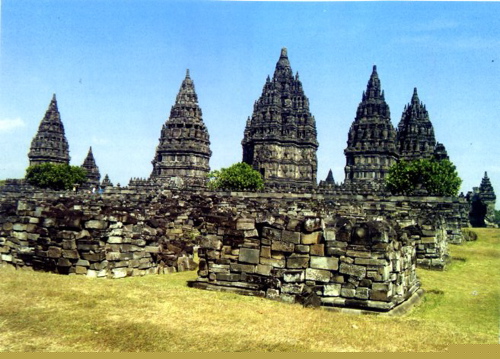
Whoa! An enormous Hindu complex constructed about a century after Borobudur - multiple spires shooting up into the sky. Instead of 1, there are 3 main structures, the center tjandi (shrine) is devoted to Shiva, the one on the left to Vishnu, and the right to Brahma: the Trimurti (the 3 gods, Destroyer, Preserver, and Creator).

Moving closer, we appreciate the vegetal look of the shrines. The tjandis almost look porous, especially compared with Borobudur, which seemed to be a solid block of stone. We notice the immense amount of rubble scattered everywhere, presumably remnants of over 100 smaller shrines that have yet to be reconstructed.
The main temple to Shiva is so tall (47 meters, over 140 feet) that we must wear hard hats to protect us from the potential of falling debris. Notice the makara railings to the right of Laurie in the photograph.
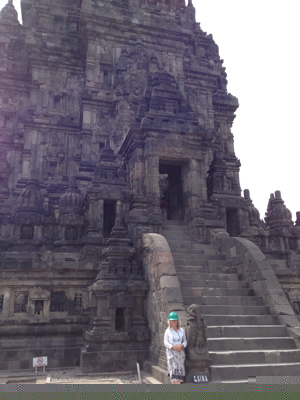
As at Borobudur, a balustrade on the lower level creates a corridor with walls containing panels on both sides. In contrast to Borobudur, the walls are not tall enough to prevent one from seeing out. Plus there is only one level that contains the bas-reliefs as compared with Borobudur's four. The Prambanan temple complex invests more artistic energy in the height of the temple and less in friezes.

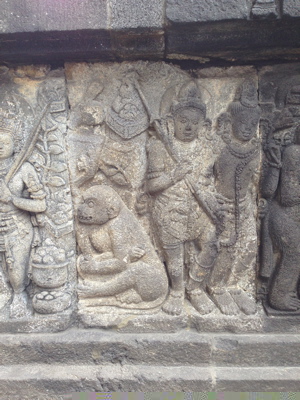
The complete story of the Ramayana is etched into the high bas-relief along the walls – not just scattered scenes, but the entire narrative. The panels are engraved with successive scenes including Rama, Sita, Hanuman the monkey king, and Ravana the demon king.

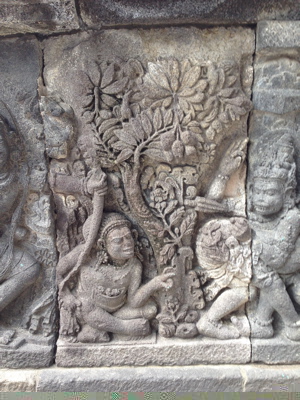
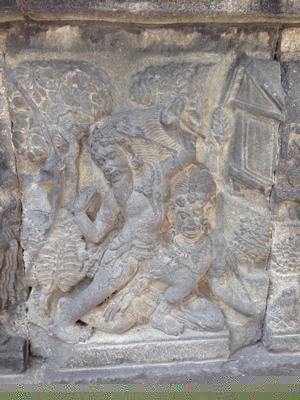


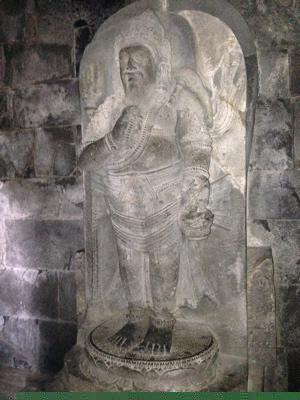
In the center of each tower there is a greater than life size (9 feet tall) sculpture of the deity to whom the particular tjandi is devoted to. Here is Shiva as the mahaguru, the great guru.
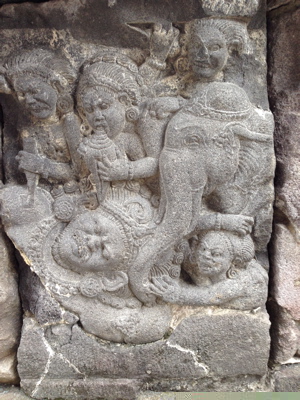
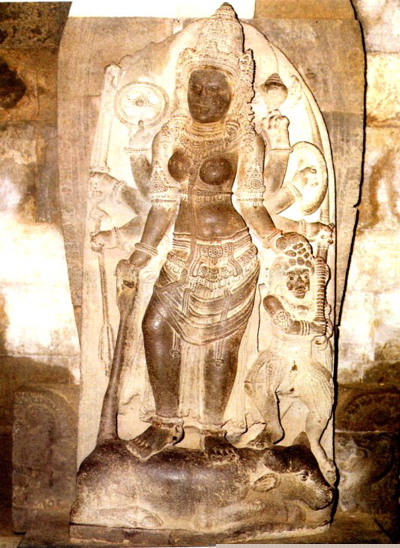
The Shiva shrine also includes a separate room in the back to house a sculpture of his consort, Durga. It is of equal magnificence. The mythological scene shows Durga drawing a demon from a cow that she has conquered. This narrative is not from Hindu mythology, but is instead a Javanese story. This is yet another indication of how the Javanese didn't copy the Hindu religion slavishly, but made it their own.
Besides the friezes and the internal statuary of the gods, there are many mythological scenes and creatures that adorn the temple.
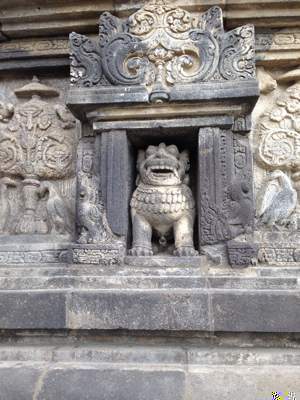

These representations include the ubiquitous Kala/Makara representations that we saw at both Borobudur and the Dieng Plateau. Time swallows everything, even as we cultivate vitality. This is a powerful symbol indeed.


Evidently, in the original shrines, there were fountains spouting water from the mouth of the Makaras, again emphacizing fecundity as a symbolic feature of the half animal-half fish like creature.

There are multiple temple spires of lesser, but still grand, size surrounding the big three. One of these presumably houses the cremated remains of the raja/king who created the masterpiece. The symbolism presumbly equates the king and his dynasty with the gods.

As we are leaving the complex to rejoin the group, an Indian accompanied by his daughter approaches me with a fervent look on his face. He points to me and exclaims adamantly. “You must go to India!� After pleasantries, introductions and such, we exchange contact information.
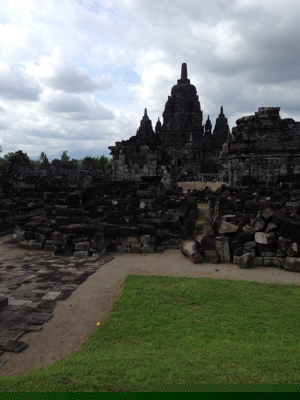
Martin has read that there is a Buddhist complex a little further away that was created at the same time. We race at Olympic speed-walker pace. Laurie begs us to slow down, as she can’t keep up – her legs too short. After passing a shrine that is under construction, an enormous Buddhist temple complex greets us – guarded by gigantic statues.


There is no one else there, neither security guards nor tourists. Martin likens it to an alien space ship. It is similar in design to the Hindu temple complex we just saw – a primary shrine surrounded by multiple smaller shrines, all in various stages of reconstruction. Note that the spires have the shape of a Buddhist stupa, solid and gradually moving towards a peak. In contrast, the towers on the Hindu shrines are bulbous, vegetal, and somewhat diaphonous.

Instead of Hindu gods, the shrine presumably housed Buddhas, all of which have been stolen or removed. We all go our separate ways to explore the temple complex. All alone, I sing and resonate with the structure – at one with the Universe.

We race back by another route to rejoin the others. Surprise of surprises. Along the way, we see a Buddhist deer park – a simulation of where the Buddha gave his first lecture after becoming enlightened. Who is there? The same Indian father and daughter. “I am rich and a publisher, Send me your book. Maybe translate into Malay.�


After relating the encounter, Martin says, “I am but a cog on your Dharma wheel. Maybe he is next. The Wheel keeps turning. Around and around. First on the top and then on the bottom.�
Exhausted, we collapse at the hotel, not fancy, but located in the heart of Yogyakarta. After a long nap we walk the night market – shopping for clothes and who knows what. A busy marketplace with high quality goods and incredibly polite vendors. Virtually, no one is hawking their wares, but just waiting patiently for us to express interest. Laurie buys her clown, me, a beautiful batik shirt for $6 and for herself a well-made leather purse for $15. Then who do we see for a 3rd time – the Indian and his daughter. Stunned, Laurie says, “This is not a coincidence. We will meet again.�
I’m exhausted by the shopping and the excitement. We have a short dinner at a high quality Chinese style restaurant. Then back to the Market. Marvelous street musicians playing a collective gamelan, traditional Javanese percussion instruments. In exultation, I dance with the youth. People take my picture – others give a thumbs-up – the dancers beg me to stay. But we must get back to the hotel to say our goodbyes to Martin and settle affairs.
After sharing a few beers and reminiscing on our marvelous adventure, Martin tallies up our share of the trip. He has paid for all the food and the transportation. But we owe him for the hotels. He says he could easily pay that as well, but it is important that we pay that to balance our interaction. It is $340 for the mountaintop resort, 2 nights in Borobudur, the Gallery Hotel in Wonosobo, and the night here in Yogyakarta. (We already paind for the 2 nights in Jakarta – $100.) I offer him $400. He insists on the exact amount – no more, no less. An amazing and inexpensive journey. On to Bali, the last leg of our trip in just 15 minutes. Must meet William the Driver in the lobby at 6AM to catch an airplane to Denpesar.